Digital Signal Intelligence, signal gravity, and the incrementality ledger
Digital Signal Intelligence will not become a procurement category. Signal gravity pulls every horizontal sensing layer down into the suites that already own the data, the way it pulled the CDP into the warehouse between 2020 and 2026. The defensible wedge underneath it is the incrementality ledger: a first-party record of which signals and actions caused pipeline, proven by holdout rather than inferred by attribution.
By Shalvi Singh. Published August 7, 2026. Figures current as of this date.
Digital Signal Intelligence is the pitch that a company's scattered digital traces, website behavior, product usage, hiring, funding, news, review-site activity, support tickets, can be fused into one self-learning layer that tells every team what to do next. The pitch is architecturally coherent and commercially dangerous, because it rests on an assumption the last twenty years of enterprise software have quietly falsified: that owning more signal domains is the winning move. Vendors keep building horizontal sensing layers, and platforms keep swallowing them. The question worth asking is not whether an organization can be modeled as a live graph of customers, operations, and risks. The question is whether anyone will buy that graph as a category, or only ever rent it as a feature inside a suite they already own.
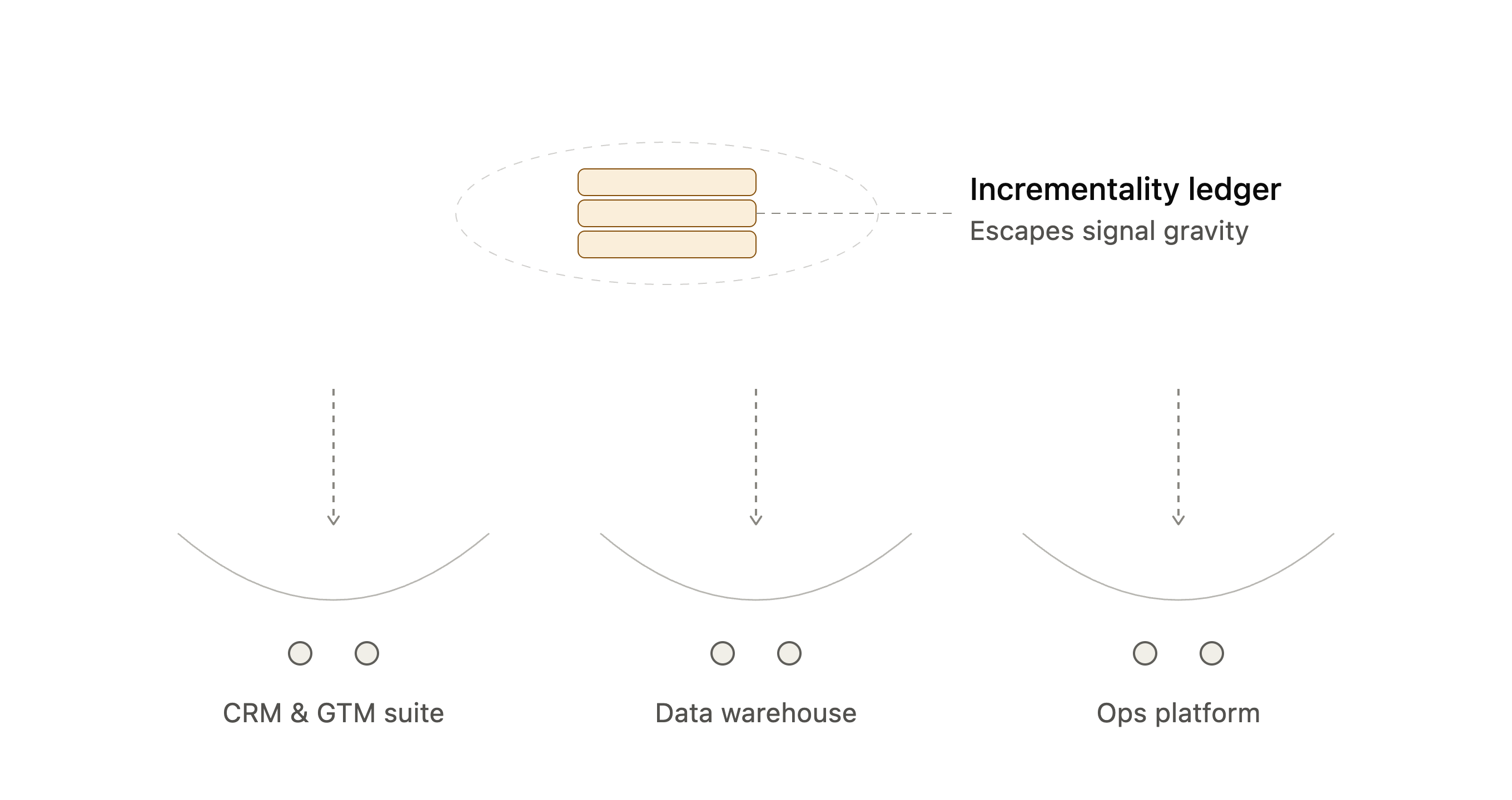
Two forces decide the answer, and naming them is the point of this piece. Signal gravity is the tendency of each signal domain to stay bound to the buyer, workflow, and data source that produced it, which is why horizontal sense-everything platforms get absorbed into suites rather than bought as a standalone category. The incrementality ledger is the proprietary, first-party record of which signals and actions demonstrably caused pipeline and revenue, proven by holdout rather than inferred by attribution, and it is the one compounding moat a signal-to-pipeline company can build that the platforms cannot copy from a data feed. Signal gravity is why Digital Signal Intelligence fails as a category. The incrementality ledger is why the narrow wedge underneath it can still become a company.
Digital Signal Intelligence is an architecture, not yet a category
Digital Signal Intelligence describes a real architecture and an unproven market, and conflating the two is the first mistake founders make. The architecture is legible: ingest signals, resolve them to an entity, estimate a state, predict, recommend, act, and learn from the outcome. Gartner has sold a version of the closed loop as "decision intelligence" since 2021, and Palantir has shipped the ontology-plus-action pattern to enterprises for longer than that. A category, by contrast, requires a buyer with a budget line, an analyst quadrant, and a procurement process that treats the thing as a system rather than a component. No such budget line for "signal intelligence" exists in 2026. Revenue teams buy intent data, marketing teams buy a CDP, security teams buy detection and response, and each of those budgets is guarded by a different owner who does not want a horizontal layer sitting on top of theirs.
Horizontal sensing concepts have been proposed and absorbed on a roughly decade-long cycle since the 1990s. Complex event processing promised a real-time nervous system in the 2000s and ended up as middleware inside application servers. The "real-time enterprise" and the "digital nervous system" were consultant frames that never became procurement categories. The pattern is consistent enough to state as a rule: a horizontal layer that senses across functions is absorbed by the systems of record beneath it unless it owns a data or feedback asset those systems cannot reproduce. Digital Signal Intelligence, as a pitch to sense everything, walks straight into that pattern.
What is genuinely new in 2026 is the enabling stack, not the ambition. Large language models collapsed the cost of turning unstructured signals, earnings calls, job posts, support transcripts, into structured features, and agent frameworks made it feasible to orchestrate the action step that older sensing platforms left as an exercise for the buyer. The Princeton GEO study (Aggarwal et al., presented at ACM KDD 2024) is a useful reminder of how fast the retrieval layer itself is changing: adding statistics to a passage improved its visibility in AI-generated answers by roughly 41 percent, and citing external sources lifted low-ranked content by about 115 percent. Capability moved. Whether the category moved with it is a separate claim, and the honest answer is that it has not, at least not yet.
Signal gravity explains why sense-everything platforms get absorbed
Signal gravity is the reason the customer data platform, the closest analogue to the Digital Signal Intelligence pitch, became a feature of the data warehouse rather than a durable independent category. The CDP promised exactly what Digital Signal Intelligence promises: unify fragmented signals into one profile and activate across every channel. The ending is now on the record. Twilio bought Segment, the vendor that defined the modern CDP, for about $3.2 billion in 2020, and between December 2024 and May 2025 four more CDPs with real revenue stopped being independent: ActionIQ went to a conversational-AI firm, mParticle to an ad-tech business, Lytics to a content-management vendor, and Census to a data-pipeline company (perform.digital, June 2026). Not one acquirer was another CDP, and not one wanted the same thing. Absorption, in that analyst's phrasing, is the default ending for the category.
The warehouse finished the job in 2026. Databricks shipped CustomerLake to run customer data inside the lakehouse, Salesforce Data Cloud rebuilt its pitch around zero-copy federation against Snowflake and BigQuery rather than ingesting the data, and Adobe added Federated Audience Composition to build audiences against warehouse tables without importing them (Datawhistl, July 2026). A few years ago the packaged pitch was "bring your data into our platform." The flagship feature in 2026 is explicitly about not moving the data at all, which is a packaged incumbent conceding that the customer's warehouse, not the vendor's storage, is the substrate. Signal gravity pulled the intelligence layer down toward the data it needed, and the data lived in the warehouse.
Each signal domain has its own gravity well, and the table below maps where the mass sits. A Digital Signal Intelligence platform that tries to span every row is competing with the incumbent owner of every row at once.
| Signal domain | Native owner in 2026 | Why the signal stays there |
|---|---|---|
| Buyer intent and account activity | 6sense, Demandbase, CRM suites | Bound to the CRM system of record and the RevOps budget |
| Product usage and telemetry | Product analytics and the data warehouse | Generated in first-party infrastructure the team already runs |
| Customer health and support | Success and support platforms | Tied to the ticketing and NRR workflow that acts on it |
| External events, news, and risk | Dataminr, AlphaSense, Signal AI | Sold to risk, comms, and research buyers, not RevOps |
| Machine and asset telemetry | Augury, Samsara, C3 AI | Physically bound to sensors and the operations team |
| Web and identity signals | CDPs, now the warehouse | Absorbed into first-party data infrastructure |
The lesson of signal gravity is not that horizontal platforms are impossible. The lesson is that the horizontal pitch loses the procurement fight unless it carries an asset with its own gravity, something the buyer cannot get by turning on a native feature in the suite they already pay for. Signal collection is not that asset, because collection is exactly what the platforms are racing to commoditize.
Intent data correlates with pipeline; it has not been shown to cause it
Intent data has a correlation record and an incrementality problem, and the gap between the two is where most GTM budgets quietly leak. The correlation is real and it is large. A 2024 B2B buying study found that intent-prioritized accounts converted to closed opportunity at 21.3 percent, versus 8.4 percent for accounts not prioritized by intent signals, across a January-to-September 2024 fielding window (The Starr Conspiracy, 2024). Demandbase research puts close rates 1.5 to 2 times higher for teams using intent data over firmographics alone. Read quickly, those numbers look like proof that intent data works.
Read carefully, those numbers describe selection, not causation. Accounts that generate research spikes are accounts already in a buying cycle, so prioritizing them and then closing them at a higher rate confounds the signal with the underlying intent to buy. The market's own results expose the gap. DemandScience's State of Performance Marketing report found that 91 percent of B2B marketers use intent data while only 24 percent report exceptional ROI, and that 66 percent of leaders say their campaign metrics look successful yet fail to drive revenue. Gartner's 2024 revenue-technology research added the mechanical reason: more than half of B2B organizations cannot map external behavioral data to identifiable buying-group members with confidence. A signal you cannot attach to a person you can act on is a signal you cannot bank.
The buyer's behavior compounds the problem. 6sense's 2025 Buyer Experience Report, drawn from more than 4,000 buyers, found that 94 percent of B2B buying groups had already ranked their preferred vendors before ever talking to sales. Buying groups now average 11 people and 11.3 months to reach a decision, with 74 percent reporting unhealthy internal conflict along the way (6sense, 2024). A surge signal that fires after the shortlist is set is measuring a race that is already over. The uncomfortable synthesis is that the intent-data category has spent a decade optimizing the detection of signals whose incremental effect on revenue nobody has rigorously isolated. Detection improved. Proof of cause did not.
Attribution measures correlation; the incrementality ledger measures cause
The incrementality ledger is the proprietary, first-party record of which signals and actions demonstrably caused pipeline and revenue, proven by holdout rather than inferred by attribution. Attribution answers a backward-looking question: of the deals that closed, which touches did the model credit? Incrementality answers the only question a budget owner should care about: of the deals that closed, which would not have closed without the action we took? The two diverge violently whenever a system prioritizes accounts that were going to convert anyway, which is precisely what an intent model trained on historical wins is built to do. An attribution dashboard will call that a triumph. A holdout will call it a rounding error.
Attribution and incrementality are not two flavors of the same measurement. They are different questions with different failure modes, and the table makes the divergence concrete.
| Dimension | Attribution | The incrementality ledger |
|---|---|---|
| Question answered | Which touches get credit for closed deals | Which actions caused revenue that would not have happened otherwise |
| Method | Correlational weighting across the funnel | Randomized holdout and uplift measurement |
| Failure mode | Rewards prioritizing sure-thing accounts | Requires withholding action from a control group |
| Who resists it | Nobody; it flatters everyone | Sales leaders who dislike untouched accounts |
| Defensibility | Low; every vendor reports it | High; the labels are unique to the operator |
| What it becomes | A reporting feature | A compounding data moat |
The reason the incrementality ledger is a moat and attribution is not comes down to who can reproduce the asset. Any vendor can buy the same Bombora intent feed and report the same attribution model, which is why the Forrester Wave for B2B intent data (Q1 2025) named five Leaders, Intentsify, 6sense, Bombora, Informa TechTarget, and Demandbase, reselling and repackaging a shared pool of signals. No vendor can buy your record of which withheld accounts converted anyway, because that record only exists if you ran the experiment on your own pipeline. The incrementality ledger accumulates one defensible label at a time, and the labels are worthless to a competitor because they are conditioned on your product, your motion, and your reps. Signals commoditize. Verified causal labels do not.
The moat is the incrementality ledger, not the signal feed
The moat in a signal-to-pipeline system is the incrementality ledger, and treating the signal feed as the moat is the error that turns a company into an acquisition target. Founders reach for signal breadth because it demos well and it is the thing a pitch deck can count. Signal breadth is also the most copyable asset in the entire stack, because the same third-party providers sell the same feeds to every buyer, and the warehouse vendors are folding first-party signal capture into the platform layer for free. A company whose only differentiator is "we watch more signals" has built its moat out of the one material the incumbents are actively giving away.
The defensible version inverts the emphasis. Signals become raw input, and the proprietary asset is the closed loop that records, for this specific customer, which recommended action produced incremental pipeline against a control. The Starr Conspiracy's 21.3 percent versus 8.4 percent conversion gap is a correlation any vendor can quote. An operator's own measured uplift, say a verified incremental win-rate lift on accounts the model told reps to work versus a randomized holdout, is a number no competitor can produce and no platform can copy from a data-sharing agreement. Signal volume is not a moat. The incrementality ledger is the asset with its own gravity, the thing that lets a horizontal-looking product survive the signal-gravity absorption that killed the CDP.
If the moat is causal labels rather than signal volume, then the product roadmap reorders itself. If the ledger is the asset, then experimentation infrastructure, holdout management, and uplift measurement are the core product and the signal connectors are the commodity input, because the connectors can be bought and the ledger cannot. Most GTM vendors have this backwards, spending engineering on ingesting one more signal source while shipping attribution reporting that flatters the buyer and proves nothing. Feeds commoditize. Labels do not. The company that wins signal-to-pipeline will be the one whose customers cannot leave, because leaving means abandoning years of accumulated evidence about what actually moves their revenue.
"Self-learning" means a measured feedback loop or it means nothing
Self-learning is a defensible claim only when a system grades its own updates against verified outcomes, and in most GTM products the phrase is marketing painted over a static model. Honest self-learning in an enterprise system requires three components: an instrumented outcome, a label tied to that outcome, and a retraining or policy update gated on the label. Absent those three, a "self-learning" product is a model retrained on the vendor's schedule against proxy labels like email opens and booked meetings, which teaches the system to reproduce whatever bias its training data already carried. Anthropic's own retrieval research is a useful cautionary mirror here: RAG-enabled GPT-4o still left roughly 30 percent of individual statements without source support (Wu et al., Nature Communications, April 2025), and a FAccT 2025 study found that 50 to 90 percent of citations in AI answers did not fully support the claims they were attached to (Venkit et al., 2025). A system that learns from a model's confident rationale rather than a verified outcome is learning from fluent text, not from cause.
The incrementality ledger is the honest version of self-learning, because the only labels it trusts are treated-versus-holdout outcomes. C-SEO Bench (Puerto et al., 2025) found that most conversational-optimization tactics did not help and others actively hurt performance, while plain source relevance kept working, which is the same lesson in a different domain: an optimization loop with no verified outcome can move a metric while degrading the result. The decision rule for any buyer evaluating a "self-learning" claim is blunt. If a vendor cannot name the outcome its model is graded on and state how often that label is verified, then treat the system as a static model with a retraining schedule, because a feedback loop without a verified outcome does not learn, it entrenches. A model that grades itself on meetings booked will get very good at booking meetings that never become revenue.
Person-level de-anonymization is where the wedge meets legal risk
Person-level de-anonymization is the highest-risk signal in the GTM stack, and the risk is legal before it is ethical. Identifying the company behind anonymous web traffic through IP-to-company matching sits largely outside GDPR scope, because it does not process personal data, and it reaches match rates of 30 to 75 percent on B2B traffic (Factors, July 2026). Identifying the named individual is a different legal object entirely: person-level reveal reaches only 10 to 30 percent of US B2B traffic, is largely unavailable in the EU, and tools such as RB2B restrict non-US visitors to company-level identification specifically because of GDPR and international privacy constraints. A wedge built on person-level reveal is a wedge with a hard geographic ceiling and a live regulatory exposure. The ceiling is geographic.
Accuracy is the second trap, and vendor claims do not survive independent testing. An independent Gartner-auditor accuracy study of eight visitor-identification platforms (March 2026) sent known contacts across three live B2B sites and found results varying dramatically, with the top performer correctly identifying 82 percent of known visitors through deterministic matching while others returned the wrong person or no person at all. Vendor claims of 90 percent match rates rarely hold up against controlled tests. The claims inflate. A signal-to-pipeline system that triggers automated outreach on a probabilistic person-level guess is one false positive away from emailing the wrong named individual at the wrong company, and every such error is both a wasted contact and a compliance event.
The decision rule follows directly from the numbers. If a target market includes the EU, or if the planned action is automated person-level outreach, then default to account-level signals and human-reviewed person resolution, because the person-level match rate under 30 percent and the GDPR exposure make automated individual targeting a liability rather than an edge. Account-level signal, resolved to a buying group and worked by a human, carries most of the value at a fraction of the legal and accuracy risk. The incrementality ledger does not care which signal fires; it only cares whether the action that followed produced incremental revenue, which means the safest signals can still anchor a defensible product.
The wedge is expansion and churn, not top-of-funnel intent
The strongest initial wedge for a signal-to-pipeline company is expansion and churn, not net-new intent, because those outcome labels arrive in weeks while a net-new decision takes 11.3 months (6sense, 2024) and cannot close the loop inside a contract year. The 90-day ROI requirement that every RevOps buyer imposes collides head-on with B2B sales-cycle length: buying groups take 11.3 months to decide (6sense, 2024), so a system aimed at net-new pipeline cannot honestly close its feedback loop before the first renewal conversation. Expansion and churn signals resolve inside the installed base, where the entity is already known, the product-usage data is first-party, and the outcome, renewed, expanded, or churned, is observable in weeks, not quarters. The wedge that can prove incrementality quickly is the wedge that can build a moat quickly. Speed of feedback is everything.
The build-versus-buy question sharpens once the wedge is fixed, and it splits by where the defensible asset lives.
| Approach | Best when | Weakness |
|---|---|---|
| Buy 6sense or Demandbase | Net-new ABM at enterprise scale, budget above $100k/yr | Shared signal pool; average 6sense contract near $123,711/yr (Vendr), no proprietary causal labels |
| Buy a point tool like Warmly | Inbound visitor activation, fast setup, mid-market | Chat-and-signal bound; Warmly modules from $10k to $20k/yr, thin moat |
| Buy Clay for orchestration | Programmable enrichment and prospecting workflows | Orchestration layer, not proprietary intelligence; commoditizes fast |
| Build the incrementality ledger | Expansion and churn on first-party usage data | Requires holdout discipline reps resist; slow to demo |
The decision rule for the wedge is explicit. If a company sells to the installed base, has first-party product-usage data, and can define a clean renewal or expansion outcome, then build the ledger on expansion and churn first and expand into net-new later, because the outcome labels arrive in weeks and compound into the moat that net-new motions cannot build inside a sales cycle. A team without first-party usage data and without a way to run holdouts should buy an intent tool and skip the platform ambition entirely, because it has neither the raw material for the ledger nor the discipline to fill it.
The buyer is RevOps, and the budget it displaces is intent data
The economic buyer for a signal-to-pipeline system is the RevOps or revenue leader, and the budget it competes for is the intent-data line that already runs $12,000 to $300,000 a year. Enterprise 6sense contracts average near $123,711 annually (Vendr), Warmly's modules run from $10,000 to $20,000 a year depending on the agent, and the intent-provider market as a whole spans roughly $12,000 to $100,000-plus per year across vendors (Autobound, February 2026). That existing budget is the wedge's structural advantage, because a founder is not asking a CFO to create a new category line, only to redirect an intent line that 66 percent of leaders already suspect is not driving revenue (DemandScience). Displacing an underperforming budget is a shorter sale than inventing one. The budget already exists.
The same fact that helps the wedge is the platform risk that threatens it. A line item RevOps already funds is a line item 6sense and Salesforce can defend by bundling the capability into a contract the buyer is renewing anyway. Pricing should therefore follow the moat, not the market: charge on accounts under management or on verified incremental outcomes, not on signal volume, because a signal-volume price commoditizes at exactly the rate the underlying feeds do. The retention driver is the accumulated ledger itself, since a customer who leaves abandons years of evidence about what moves their revenue and starts a competitor's holdout history from zero. The decision rule for pricing is direct. If the buyer already funds an intent line with no holdout-proven ROI, then replace that line with an outcome-priced ledger rather than adding a new tool, because the budget is already defended and the incumbent cannot demonstrate incrementality any better than the buyer can.
What to build first is the loop, not the lake
The first component to build in a signal-to-pipeline system is the outcome-measurement loop, not the data lake, because every layer beneath the loop is buyable and the loop is the only part that becomes a moat. The reference stack splits cleanly on the build-versus-buy line. Ingestion, connectors, change-data-capture, and event streaming, is a buy, served by a dozen commodity vendors. The data foundation of a lakehouse and a feature store is a buy, and increasingly the customer already runs one, given that Salesforce, Adobe, and Databricks all now federate against the warehouse in place (Datawhistl, July 2026). Identity resolution is a buy-or-partner with a known ceiling, since Gartner's 2024 research found more than half of B2B organizations cannot map external behavioral data to a buying-group member with confidence. The action layer of CRM writes and sales-engagement steps is a buy.
The learning layer is the one component to build in-house, and it is the whole company. Outcome instrumentation, holdout management, uplift measurement, experiment tracking, and a model registry that records which policy produced which verified lift are the parts no vendor sells as a product and no platform can average across its customer base. Building the lake first is the common failure, because the lake demos as progress and consumes the budget before the loop exists to prove anything. The decision rule is consistent with everything above. If a component can be bought from more than one vendor, then buy it, and spend the scarce engineering on the learning layer, because the incrementality ledger is the only asset on the architecture diagram that a competitor cannot purchase and a platform cannot federate. A signal-to-pipeline team that builds its lake first and its loop last has funded the commodity and starved the moat. Buy the lake. Build the loop.
A 90-day proof needs a holdout, not a dashboard
A credible 90-day proof of a signal-to-pipeline system is a randomized holdout, and a dashboard of influenced pipeline is the thing to refuse. The vanity trap is well documented: DemandScience found 66 percent of leaders reporting that campaign metrics look successful while failing to drive revenue, which is exactly what happens when a proof measures opens, meetings, or attributed pipeline instead of incremental outcomes. A proof-of-value that reports "the system influenced $2M in pipeline" is measuring correlation dressed as impact, because it never asks what the untouched accounts did. Influenced-pipeline dashboards are the intent category's original sin, and repeating them in a new product repeats the failure.
The design that actually proves cause is boring and specific. Randomly split eligible accounts into a treated group the model prioritizes and a holdout the reps do not work on the system's recommendation, run the split for a full measurement window, and compare conversion, win rate, and expansion between the two. A treated-versus-holdout win-rate gap that survives the window is incremental lift and the first entry in the ledger. The rule for any pilot is unambiguous: if a vendor or an internal team cannot describe the holdout, the control group, and the outcome metric before the pilot starts, then the pilot will produce a correlation and call it a result, because a proof without a control can only ever measure who was going to convert anyway. A 90-day sprint with a 20 percent holdout is worth more than a year of attribution reporting.
The model's worst failure is believing its own recommendations
The most dangerous failure in a signal-to-pipeline system is the self-fulfilling model, where the system prioritizes accounts, reps work exactly those accounts, the accounts convert, and the model then reads its own influence as proof it was right. The 21.3 percent versus 8.4 percent conversion gap (The Starr Conspiracy, 2024) is the shape of the trap when it is measured without a control: prioritized accounts convert better partly because they were prioritized and worked harder, not only because the signal was predictive. A model retrained on that outcome learns to prioritize the same accounts more aggressively next quarter, and the loop tightens around a belief no experiment ever tested. The model was never right. It was only obeyed. Automation bias makes it worse, because a rep who sees a confident score is less likely to challenge it, and a hallucinated rationale from an LLM attached to the score makes the recommendation feel more grounded than the data supports.
Data-quality failure sits underneath the behavioral one and is just as corrosive. Gartner's 2024 finding that more than half of B2B organizations cannot confidently map behavioral data to a buying-group member means a meaningful share of triggered actions fire at the wrong person or the wrong account, and a person-level match rate under 30 percent in the US (Factors, July 2026) guarantees false positives at volume. The wrong person gets the email. The mitigations are specific, not aspirational. Run a permanent holdout so the self-fulfilling loop is always measured against untouched accounts, cap contact frequency so an aggressive model cannot burn the base, and require human review on any high-stakes or person-level action. The decision rule closes the red team. If a system cannot show a treated-versus-holdout gap, then assume its reported lift is self-fulfilling and do not scale the automation, because a model that grades itself on its own prioritized wins will always report success and may be destroying the base while it does.
Salesforce and HubSpot will ship the signal layer, not your ledger
Salesforce and HubSpot will absorb the signal layer, and betting against that is betting against every precedent in this piece. The platform response to intent has already begun: 6sense shipped RevvyAI and ZoomInfo shipped Copilot, moving the category from "here is your data" to "here is the recommended action," with signals auto-triggering outreach. Salesforce Data Cloud, now the center of a Data 360 story, is federating signals directly against the warehouse and pushing them into the flow of work across every Salesforce app. The signal-detection and next-best-action features that look like a startup's whole product in 2026 are the exact features the incumbents are shipping natively, and signal gravity guarantees they will keep pulling that intelligence down toward the CRM and the warehouse where the data already lives.
The incumbents cannot ship your incrementality ledger, and that is the entire bet. Salesforce can federate every signal and recommend every action, but it cannot run your holdouts, withhold action from your control accounts, or accumulate your customer-specific record of verified causal lift, because that asset is manufactured by disciplined experimentation on one operator's pipeline and it is worthless when averaged across a platform's whole customer base. A startup that positions as "more signals than Salesforce" will lose, because Salesforce is racing to make signals free. A startup that positions as "the system of record for what actually caused your revenue" is selling something the platform structurally cannot build, because the platform's scale, the very thing that makes its signal layer cheap, is what makes its causal labels generic. The wedge that survives is the one whose moat gets stronger every time the platform gets better at signals.
Where this goes
Digital Signal Intelligence will not become a procurement category in the next 24 months, and trying to name it now repeats the CDP's mistake of selling a horizontal layer before owning a defensible asset. The architecture is sound and the enabling technology finally exists, but signal gravity will pull any sense-everything platform down into the suites and the warehouse, exactly as it pulled the CDP down between 2020 and 2026. The category, if it ever arrives, will be named after a wedge that won, the way account-based marketing was named after Demandbase had traction and revenue intelligence was named after Gong. Categories get named for winners, not for architectures, and the winner here has not been chosen.
The bet worth making is narrow and unglamorous. Build the incrementality ledger on expansion and churn, prove it with holdouts inside 90 days, refuse the influenced-pipeline dashboard, and let the signal connectors stay the commodity they are becoming. The company that owns the record of what actually caused its customers' revenue owns the one asset Salesforce cannot federate and no competitor can copy. Signal gravity decides who gets absorbed. The incrementality ledger decides who does not.